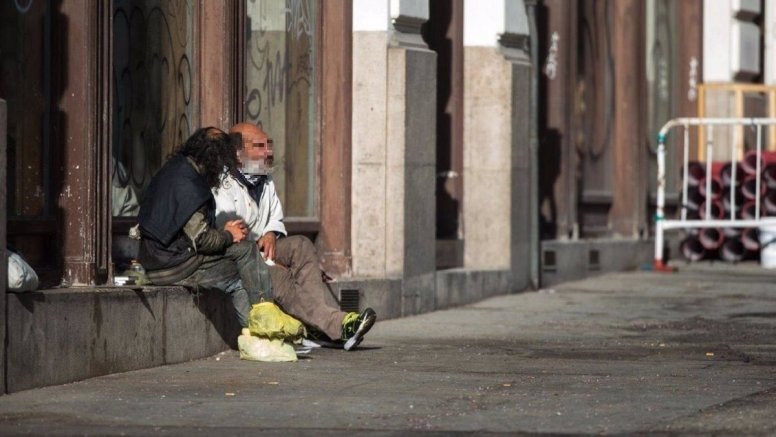
The president of the Canary Islands, Fernando Clavijo, expressed this Monday his "concern" about the increase in inequality between the poor and the rich in Canary Islands during his visit to the Social Work of Reception and Development in Las Palmas de Gran Canaria, where he ratified the commitment of the regional Executive to "help those who help".
"We have a record of affiliates in Social Security, but the reality is that what has happened in these years, as always happens in crises, is that the poor are poorer and the rich are richer, and the difference and the 'gap' (gap) that is occurring between the most humble of our society and those who do accumulate more resources is widening," Clavijo told the press.
"That means that our society is not doing well," he added, pointing out the need to "rethink what kind of society we want to build for our children" and correct the "distribution of wealth and that employment is stable and is paid more dignifiedly."
Clavijo made these statements prior to a meeting with the president of the Social Work of Reception and Development, Jesús García, which was also attended by the Minister of Social Welfare, Equality, Youth, Childhood and Families, Candelaria Delgado, the Deputy Minister of Social Welfare, Francis Candil, the director of the Social Work of Reception and Development, Agustín González, and the honorary members of the entity, Sebastián Grisaleña and Juan Miguel Sanjuan.
The president of the Social Work of Reception and Development declared to the media that the Canarian Government is "the only administration that already has all the tasks done" in relation to the organization's requests, mainly related to "the needs of economic resources."
García explained that the Social Work currently accompanies around 200 people "who are not on the radar of the administrations" because they are staying in the "last step" of poverty and "many times they are not seen because they are not even documented or registered in any municipality," which gives rise to a "poverty pocket" that is "very difficult to address."
He also warned that the number of people in this situation has "increased in recent years" because "we have had many consecutive crises and, at the present time, with the increase in the cost" of living "no one has money to give donations."
The Minister of Social Welfare, Equality, Youth, Childhood and Families has confirmed that "an increase" in the population at risk of social exclusion is being assisted and that "it is necessary to design public policies that accompany these people but also create programs that allow them to get out of the spiral of poverty in which they find themselves."
Delgado has warned that "this increase is due to the fact that, although the minimum wage has been rising, the cost of living in the Canary Islands has also increased," and has lamented that "the scope of the Minimum Living Income in the Canary Islands has not been raised more."
In that sense, the Minister has pointed out that "they are in contact with the state government to see how they can collaborate so that more and more families in the Canary Islands can receive it" and, in this way, the regional government can "dedicate the Canarian Citizen Income to supplements such as non-contributory pensions or aid for those families who, even working, cannot make ends meet."
Add La Voz de Lanzarote as a preferred Google source.
Stay informed with the latest current news.