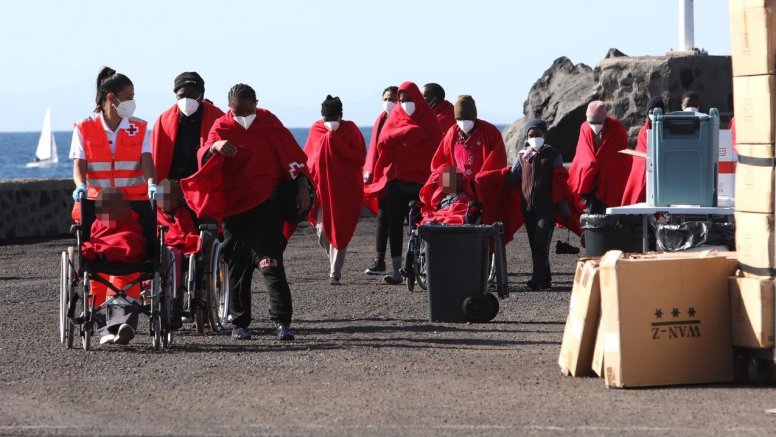
The Junta de Castilla y León assured this Wednesday that its capacity to welcome migrant minors from other territories is "almost at its limit", with more than 200 unaccompanied minors in its spaces dedicated to this purpose, after the Canarian president, Fernando Clavijo, stated this Wednesday that this Community had offered to welcome more if necessary.
Sources from the autonomous Executive have conveyed to EFE, after learning of the words of the Canarian president, that the Junta maintains its position of solidarity with respect to migrants and the autonomous communities that have greater pressure, in reference to the Canary Islands and the autonomous cities of Ceuta and Melilla.
However, the Junta has clarified that "any change in the distribution of minor girls and boys unaccompanied by the Government of Spain must be done from the agreement with the autonomous communities and with the contribution of sufficient resources to guarantee the necessary attention".
For this reason, the Government of Castilla y León has insisted on the need to urgently convene the Conference of Presidents, while the same sources have rejected any type of "imposition" by the Executive of Pedro Sánchez to "try to cover up his incompetence and ineffectiveness in his immigration policy".
This Wednesday, the president of the Canary Islands, Fernando Clavijo (Canarian Coalition), stated that the regional presidents of Castilla y León and Galicia, Alfonso Fernández Mañueco and Alfonso Rueda, both from the PP, have offered to welcome a greater number of migrant minors than those agreed in the last sectorial if necessary.
In statements to journalists during a visit to the University Hospital of the Canary Islands, Clavijo assured that the agreement for the distribution of migrant children and adolescents is being fulfilled, "each community at its own pace", and has thanked the offer from communities such as Galicia and Castilla y León.
Thus, the Canarian president has pointed out that instead of the nearly 400 minors that were agreed in the sectorial immigration conference in July, it could exceed 600, and has recalled that there are many of those adolescents who, immersed in the system, turn 18 without having their documentation in order.
Galicia denies that there has been a conversation
For its part, and after Clavijo's statements, the Xunta has specified to EFE that the Galician president, Alfonso Rueda, has not spoken with the Canarian president about the arrival of more migrant minors and has recalled that it is still pending to receive forty.
Sources from the autonomous Executive point out that "until now" they have welcomed "all the minors agreed in the distributions made between autonomous communities". In addition, as of today, forty of these minors are still pending arrival, something about which the Xunta has no "news".
The president of the Canary Islands stated this Wednesday that the regional presidents of Castilla y León and Galicia, Alfonso Fernández Mañueco and Alfonso Rueda, have offered to welcome a greater number of migrant minors than those agreed in the last sectorial if necessary. However, from the Xunta they clarify that Rueda "did not hold any conversation on this matter with the president of the Government of the Canary Islands".
"Any change in the distribution of unaccompanied minors or any decision must be made in accordance with the autonomous communities and with the contribution of the necessary resources to guarantee the necessary attention", warns the Galician Government.
It also adds that "it is necessary that this issue be addressed as what it is, a State problem, in which the Government leads and coordinates the autonomous communities".
"Measures are needed to address the issue and that the central Government provide the necessary funds and coordinate all the autonomous communities involved, with planning and transparency", insist from the Galician Executive.
In addition, they point out that "Galicia was, is and will always be in solidarity and will continue to collaborate with the rest of the autonomous communities welcoming immigrant minors, to the extent of its possibilities and in a planned and orderly manner, depending on the availability of places in the reception system".
They recall, in that sense, that they are "minors who require personalized and adequate treatment".
Add La Voz de Lanzarote as a preferred Google source.
Stay informed with the latest current news.