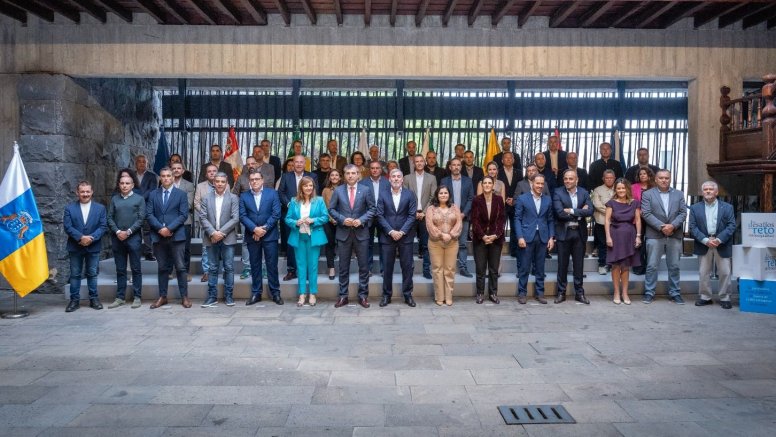
The Government of the Canary Islands and the 47 least populated municipalities of the Archipelago have agreed this Thursday to launch a Sustainable Rural Development Plan for the Canary Islands.
President Fernando Clavijo and the head of the Canary Islands Federation of Municipalities (FECAM), María Brito, "consider it essential to have an integral plan again that articulates and finances measures to tackle, from an economically and socially sustainable vision, the loss of inhabitants in the rural areas of the archipelago."
During the first meeting with the mayors of the Canary Islands municipalities with fewer than 10,000 inhabitants, Clavijo announced that the Sustainable Rural Development Plan will include an "important" financial sheet. Initially, the plan will be endowed with funds from the autonomous community, but the Government of the Canary Islands will negotiate with the State the contribution of resources from the national plan for Empty Spain and will also seek financial support from the European Union through its various lines of aid to the rural environment.
In addition, the president has guaranteed that the new Plan will inject extra resources into the 47 Canary Islands municipalities facing the demographic challenge, a figure higher than the 32 municipalities recognized by the previous document. The drafting of the 2014-2020 plan only included those that met the requirements of the national 'rurality index', a criterion that will now be updated by adding the criterion of having fewer than 10,000 inhabitants.
Clavijo thanked the representatives of these municipalities for their collaboration in the open debate in order to "ruralize" all public policies and put into practice the "great agreement" reached at the first Conference of Presidents for a more economically, socially and environmentally sustainable Canary Islands. "There is a consensus at all three administrative levels on the need to move towards a sustainable development model for the Canary Islands and also on the need to do it together," he stressed to the mayors.
Basics for sustainability
During his speech, the President of the Canary Islands highlighted the need to "create new opportunities" in the municipalities with fewer inhabitants and improve the quality of life of their population, because "they are basic" for the Canary Islands and "essential" in the construction of a more sustainable archipelago thanks to their contribution to the landscape, the primary sector and traditions.
To achieve this, Fernando Clavijo has made a commitment that the regional legislation and all those initiatives promoted by the Government contemplate exceptions and special treatment for the Canary Islands municipalities with fewer than 10,000 inhabitants. "It is the same as we ask for as an OR in Europe and we must apply it here to meet the specific needs" of these municipalities.
For his part, the Vice President of the Government, Manuel Domínguez, stressed after the meeting the importance of focusing on measures to improve the economy in the Canary Islands municipalities that are losing population. In his opinion, increasing the living conditions of its inhabitants "involves increasing their economic opportunities", a commitment assumed by the Regional Executive with "specific measures that we will be implementing".
Another of the agreements reached at the working meeting with the 46 Canary Islands municipalities with fewer than 10,000 inhabitants plus Santa Úrsula has been the incorporation into the FECAM working groups of the needs of the municipalities affected by the demographic challenge. María Brito explained that representatives of the Government and public universities will be incorporated into these working groups when required to coordinate actions aimed especially at the least populated municipalities.
Lines of work
Government and municipalities have agreed to activate several lines of work in these tables. The first will seek the promotion and economic development in the rural world with measures for the implementation of technification processes in the primary sector, the promotion of the circular, social and collaborative economy in all its aspects, and support for markets and spaces that are committed to local products.
In addition, the autonomous Executive undertakes to improve the digitization processes in the least populated areas of the archipelago, to reduce the technological barriers that hinder their development and the access to the network of their inhabitants.
Equal opportunities for women and young people in the rural world is another of the lines of work, a line that is complemented by the promotion of access to culture in these municipalities and the approach of knowledge from universities and the Canary Islands innovation ecosystem.
Faced with the aging of the population, the Government of the Canary Islands is committed to planning measures for social welfare and the promotion of the care economy in the rural areas of the islands. The objective is to adapt public services and infrastructures to facilitate mobility and guarantee the care of the elderly in the least populated areas of the archipelago.
The role of the Canary Islands public universities and the innovation ecosystem will also be strengthened to "contribute to connecting rural and urban areas and transforming rural territories into spaces of social and economic development opportunities by bringing talent and ideas to the rural world".
This first meeting with the representatives of the 47 municipalities of the islands affected by the demographic challenge "is part of the roadmap launched by the Government since the beginning of the legislature to advance in the promotion of economic, territorial and social cohesion of the archipelago, guaranteeing equal rights regardless of the place of residence", as mandated by article 37.2 of the Statute of Autonomy.
The meeting was attended, in addition to the President and Vice President of the Government, by the Minister of the Presidency, Public Administrations, Justice and Security, Nieves Lady Barreto; the Minister of Territorial Policy, Territorial Cohesion and Water, Manuel Miranda; the Minister of Ecological Transition and Energy, Mariano Hernández Zapata; the Minister of Agriculture, Livestock, Fisheries and Food Sovereignty, Narvay Quintero; the Deputy Minister of the Presidency, Alfonso Cabello; the Deputy Minister of the President's Cabinet, Octavio Caraballo; and the Deputy Minister of Territorial Planning and Demographic Challenge, Elena Zárate.
On behalf of the local corporations, together with the president of FECAM, leaders of the organization that represents the 88 municipalities of the Canary Islands attended, in addition to practically all the mayors of the 47 least populated municipalities of the archipelago.
Add La Voz de Lanzarote as a preferred Google source.
Stay informed with the latest current news.