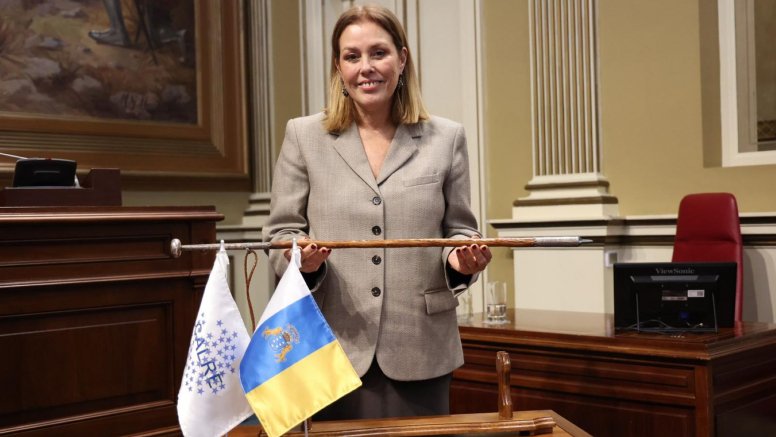
The Parliament of the Canary Islands hosted this Wednesday the plenary session of the Conference of European Regional Legislative Assemblies (CALRE), a key event in European regional parliamentarism that brought together presidents of regional and autonomous parliaments from countries such as Austria, Belgium, Spain, Italy, Germany, and Portugal in the Canary Islands.
During the plenary session, Astrid Pérez, president of the Parliament of the Canary Islands, has been re-elected president of CALRE, unanimously renewing the trust of the European regional legislative assemblies in her leadership of the organization. Pérez is revalidating her position after a first year in office marked by institutional cooperation, the defense of the regions' role, and greater international projection for CALRE.
During the plenary session, the President of the Parliament of the Canary Islands conveyed the regional Parliament's concern about the potential impact of the European Union's next Multiannual Financial Framework on the outermost regions and, in particular, on the Canary Islands. Astrid Pérez underscored the importance of current European instruments that have helped sustain strategic sectors and guarantee the territorial cohesion of the Archipelago.
In this regard, he recalled that the current European period has meant for the Canary Islands the arrival of 1.878 billion euros from POSEI for the maintenance of the primary sector, as well as 673 million euros from ERDF and the European Social Fund intended for the financing of essential public services. To these amounts, 88 million euros in fisheries compensation are added, which are fundamental to alleviate the structural overcosts derived from the outermost region status
The president warned that any reduction in these specific allocations would mean a significant loss of resources for the Canary Islands, directly affecting competitiveness, connectivity, healthcare, and strategic cooperation programs such as Interreg MAC. "We are not just talking about numbers," she pointed out, but about less support for agriculture, a reduction in the financial muscle for essential services, and a real setback compared to the previous framework that would jeopardize territorial cohesion.
Astrid Pérez defended that the new European priorities cannot translate into the disappearance of compensation for the Canary Islands, as this would mean a setback in the principle of equality enshrined in Article 349 of the Treaty on the Functioning of the European Union
Finally, the president reaffirmed the commitment of the Canary Islands to the common front of the Outermost Regions and underlined the role of CALRE as a key space for the defense of subsidiarity and multilevel governance. In this context, she highlighted the need to continue firmly defending a Europe of the regions that guarantees cohesion, equal opportunities, and respect for territorial diversity
Add La Voz de Lanzarote as a preferred Google source.
Stay informed with the latest current news.