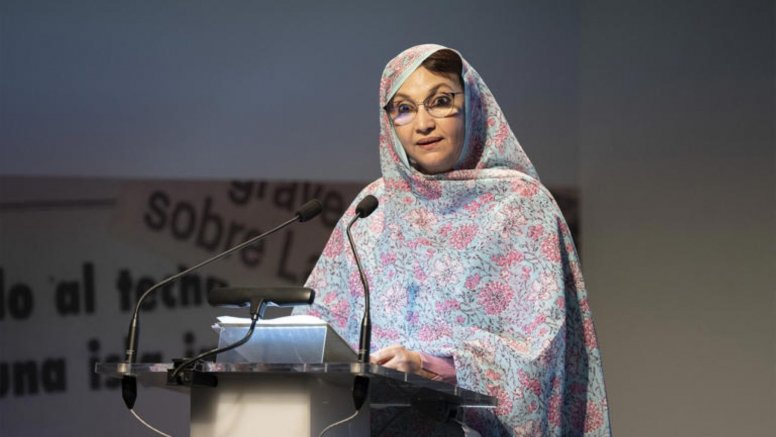
The Sahrawi activist Aminetu Haidar has warned this Thursday that the youth of her country have lost confidence in the international community and the United Nations, which is causing growing support for the armed path over peaceful resistance, after decades without progress in the decolonization process of Western Sahara.
"The new generation no longer believes in peaceful resistance. They are all in favor of war, of weapons. It is very regrettable, but I can understand them because the international community is indifferent, it does not want to apply international law," Haidar stated during a press conference held in Las Palmas de Gran Canaria on the occasion of the presentation of the film-documentary 'Aminetu'.
Haidar also warned that young Sahrawis consider "human rights to be slogans" and "no longer have any confidence in the international community," which is why they also see in Gaza and Lebanon, so "the day will come when no Sahrawi will believe in the United Nations."
This renowned defender of human rights and the Sahrawi cause has expressed her concern about the change in mentality of the new generations, emphasizing that she is convinced that the solution must be peaceful, always respecting the self-determination of the Sahrawi people, "who must have the final say."
Aminetu Haidar, internationally known for the hunger strike she undertook for 32 days at Lanzarote airport in 2009, has denounced that, after more than 50 years since Spain's withdrawal from Western Sahara, the Sahrawi people continue to suffer "exile, repression, and deprivation of basic rights" in the territories controlled by Morocco.
The Sahrawi defender, who lives in El Aaiún, has assured that arbitrary detentions and torture continue, and that there are currently at least 19 activists imprisoned, some with life sentences.
"Spain has betrayed us"
In this context, she has criticized the Spanish Government's change of position in 2022, considering that it represented support for Rabat's claims and a shift to a position where it "does not denounce the violations that Morocco is committing daily against innocent citizens and against us as human rights defenders."
"Spain has betrayed us and continues with its betrayal," he stated, pointing out that, after the change in stance by the Government of Pedro Sánchez, the situation in the Sahara "has worsened because Morocco feels very comfortable, it is enjoying total impunity," supported by Spain, France, and the United States.
The journalist and screenwriter of the documentary film, Nicolás Castellano, pointed out that "it is striking that a government that so strongly defends multilateralism and international legality and that positions itself against the occupation of Ukraine or the Palestinian territories, is in favor of the occupation of the Sahara".
Haidar also denounced that the European Union has not respected the rulings of the Court of Justice of the European Union which establish that Western Sahara is a territory distinct from Morocco and that the exploitation of its natural resources violates international law.
"Despite this, the European Union continues to steal our riches," he asserted.
Furthermore, he criticized the United Nations Mission for the Referendum in Western Sahara (MINURSO), which he described as a "mission with blindfolds"; he recalled that Morocco prevents international observers and journalists from accessing the territory, and denounced a demographic alteration strategy that has reduced Sahrawis to less than 25% of the population.
"Break the media silence"
During the press conference, the director of the documentary, Lucía Muñoz Lucena, explained that 'Aminetu', premiered last March at the Málaga Film Festival after more than two years of research, aims to "break the media silence" on this conflict and make visible the situation both within the Sahara and in the Sahrawi refugee camps in Algeria.
Muñoz explained that the team opted for the documentary format with a 'thriller' structure to broaden the reach of the message and connect with a wider audience, using intrigue as a narrative tool to unravel the human rights violations that, she assures, the Sahrawi people suffer.
The documentary was screened this Wednesday at the Cuyás Theatre, at the invitation of the Cabildo de Gran Canaria, whose Minister of International Solidarity, Carmelo Ramírez, stated at the press conference "against the whitewashing policy" that, in his opinion, the Government of Fernando Clavijo maintains regarding the Moroccan regime, in allusion to the missions of Canary businessmen to the Sahara to explore possible investments.
Add La Voz de Lanzarote as a preferred Google source.
Stay informed with the latest current news.