
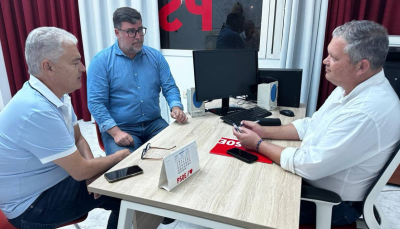
The leaders of the PSOE of Arrecife, San Bartolomé and Tías reject the introduction of private platforms, such as Uber or Cabify, to resolve the problems of the taxi sector on the island, as Oswaldo Betancort has suggested through statements made in a local media outlet.
According to Alfredo Mendoza and the mayors of San Bartolomé and Tías, Isidro Pérez and José Juan Cruz, "no one disputes that it is necessary to improve the taxi service on the island, but the solution involves listening to the sector and agreeing with the taxi drivers on the measures that should be applied. I am convinced that the taxi cooperatives on our island are capable of moving the service forward without the need for it to be privatized."
In this sense, the three socialist representatives have obtained the unanimous support of the Island Executive headed by the island secretary, María Dolores Corujo, in the last meeting held on the afternoon of Thursday, February 15. At that meeting, it was recognized that, as a result of the strong tourist demand, waiting lines occur at specific times in the Port of Arrecife and at the Airport, which in turn generates an increase in the waiting time to catch a taxi at many other stops.
Alfredo Mendoza and the mayors Isidro Pérez and José Juan Cruz agree that more taxi licenses are needed in some municipalities and that all those granted are operational. "Both issues must be agreed upon at a table where the sector is heard and where the Cabildo and the town councils are represented," they say.
On the other hand, the PSOE shares the convenience that, in certain events with a large influx of public on the island, such as some festive celebrations, carnivals or a Saborea, "taxis from other municipalities should punctually support the service provided in the host town". Likewise, "this situation could be transferred to the Port of Arrecife and the Airport in exceptional moments and in accordance with the sector".
"We have no doubt that taxi professionals are the first interested in providing a quality service to both the resident population and tourists, avoiding waits and queues at the Port of Arrecife, at the Airport or at any stop," says the PSOE. However, it recalls that in order for taxis other than those of the municipality in which both infrastructures are located to be able to pick up passengers, "the Cabildo must first declare them sensitive areas in terms of Transport".
In this sense, the general secretary of the PSOE of Lanzarote, María Dolores Corujo, considers that the declaration of sensitive areas of the Port of Arrecife and the Airport in terms of transport would allow the taxi service to be regulated in them, regardless of the municipality in which they are registered. "This initiative corresponds to the Cabildo and requires a Regulation and an electronic platform," she stresses. "If these conditions are not met, passengers could not be picked up at the Port and the Airport declared sensitive areas by taxis other than those of the municipality in which the aforementioned infrastructures are located," warns the general secretary of the PSOE.
This declaration would prevail over the articles of the ordinance that currently prohibits taxis other than those of the municipality in which both infrastructures are located from picking up passengers. The PSOE points out that only the Port or only the Airport cannot be declared a sensitive area, "but both at the same time".
Finally, the PSOE reminds that one of its electoral commitments made last May consists of creating an Institutional Taxi Table. Its mission would be "to analyze the situation of the sector and propose initiatives to improve the situation of professionals and the service provided to citizens."
On the other hand, this Institutional Taxi Table would have other tasks, such as facilitating the acquisition of adapted vehicles for taxi drivers through subsidies; greater control and inspection of vehicles that do not comply with the necessary documentation to carry out the service; improving subsidies to existing and legal taxi associations; or promoting the electric vehicle with a greater number of charging points.


