
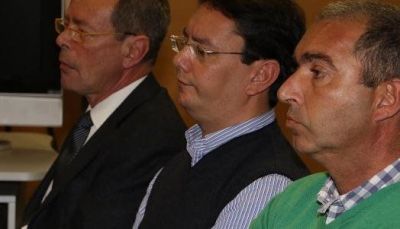
The confession of one of the defendants has marked the first day of the trial of piece number 13 of the Unión case, which began this Monday in Arrecife and which has four people in the dock for payments for allegedly unperformed work to businessman José Daniel Hernández Arráez. During his statement, the former Councilor for Finance and Urban Planning of Arrecife, José Miguel Rodríguez, has acknowledged that he is guilty of having "consented to an embezzlement" of some 250,000 euros and has shown his agreement with the facts narrated by the Prosecutor's Office. He has even already returned part of the money claimed from him as civil liability.
"With my signature, a series of procedures have been circumvented" and "third parties have been able to benefit", declared the former councilor, who authorized up to 14 invoices linked supposedly to the Festivals area to be paid from his Council, despite the fact that this department did not intervene at all in that contracting. In fact, the one who made the order was another of the defendants, who was the head of the Technical Office of Arrecife, Rafael Arrocha, according to his own statement. And he did so without making a report on the need for that expense, without calling a contest and without even asking for other budgets. Afterwards, it was also Arrocha who supposedly supervised that the work was performed.
Regarding why he signed those invoices if he believed that those works had not been carried out, José Miguel Rodríguez responded by pointing directly to the fourth defendant, the auditor Carlos Sáenz, whom he has even implicated in other cases that the Justice is investigating or has investigated. According to the former councilor, he "consented" to sign those invoices because previously the auditor "had consented to others in the same way so that I or my party could profit".
"The one who always had to be there was Carlos Sáenz"
The former councilor, who has even spoken of "small kingdoms of taifas" within the City Council, has assured that this way of proceeding was "usual in Arrecife" and has linked Carlos Sáenz, even, to a case that has already been judged, for payments for work not performed to Francisco Rodríguez Batllori. In that case, the six people who sat in the dock were convicted, but the auditor was not among them. However, Sáenz is accused in other pieces of the Unión case (including the one that has begun to be judged this Monday) and is one of the main defendants in the Montecarlo case, where alleged crimes of embezzlement are also being investigated.
"The one who always had to be there was Carlos Sáenz", Rodríguez insisted, stating that the role of the auditor was key to be able to make payments that, according to him, were fraudulent. "Did you sign because on other occasions they have helped you take money?", the prosecutor Ignacio Stampa asked him, to which Rodríguez nodded. Regarding why he believes that the works were not really performed, if Rafael Arrocha had given the go-ahead, the former councilor responded that "because of the modus operandi", which "was irregular" and that, according to his statement, was the same one they used with other fraudulent payments.
Therefore, although he assures that in this case he did not receive any economic amount in exchange, he has insisted that he did not object because previously, in the payment of other invoices to different companies, both he "personally" and his party, the PIL, had obtained "a profit". And according to him, in all those cases, "the one who was always there was the auditor".
"I have lost everything"
During his statement in the trial, Rodríguez's voice even broke. "I have lost my house, my marriage, my job. I have lost everything. The only thing I want is for my testimony to serve to clarify this situation", said the former councilor, to explain the reason for his confession (he already confessed also in the Batllori piece and assures that he is collaborating in the other two cases that he has pending trial).
In addition, both he and his lawyer have insisted on emphasizing that if he has not contributed all the money that the Prosecutor's Office claims from him in this case as civil liability, it is because he does not have the economic resources to do so. Last week, Rodríguez finally contributed something more than 2,000 euros, which is what he claims to have been able to gather, after also paying his responsibility in the other piece in which he was convicted.
The former councilor entered the City Council after the 2007 elections and was arrested two years later, in May 2009, when Operation Unión broke out. After his arrest, he spent four months in provisional prison and shortly after leaving prison, he resigned from his seat, after supporting a motion of censure that made Cándido Reguera mayor.
"They do not correspond to works or anything"
"I have authorized, I have consented through my signature to what I have consented. And those payments do not correspond to works or anything", Rodríguez responded to the defenses of the defendants, who have insisted on asking if he really knew that those works had not been carried out. "I do not know that the works were done. I should have known and I do not know", said the former councilor, who signed those invoices as councilor authorizing the payments.
Also one of the judges that make up the court has asked him if he was certain that the works were not done and why. In this regard, Rodríguez has responded by detailing the different irregularities that he considers occurred. For example, that one of the invoices was for electricity expenses for the Chaxiraxi festivities, which are celebrated in a cultural center "where it is not necessary to bring any connection". Only for the alleged electrical installation for those Argana Baja festivities in 2008, the City Council paid this businessman about 45,000 euros in two different invoices: one for assembly and another for disassembly.
Rodríguez has also emphasized that that contracting should have been carried out from the Festivals area and charging the expense to its budget, and not to the Councils that he managed (Finance and Urban Planning). He has also considered it "derisory" that what was done was to reinforce "for a few days" a line of public lighting, as the other defendants have stated. "We have not even done that reinforcement in other more interesting places", the former councilor has emphasized, insisting that it made even less sense to do it on the occasion of the Chaxiraxi festivities.
In addition, he has also spoken of splitting invoices and the need to have requested at least other budgets. In this regard, the Prosecutor's Office and the private prosecution maintain that this service should have been put out to tender, while the defenses allege that it was a minor contract because it was a work and not a service (the limit to make a direct award is 18,000 euros in the case of contracting services and 50,000 in the case of contracting works). For his part, Rodríguez has defended that in any case, "however it was, several budgets were always requested", even if a award was going to be made without a contest. "That as a minimum", he has added.
In addition, he has also said that "it was not understood" why the businessman "did not present the invoices at the time" and presented them all together in December, when he was supposedly carrying out work for the City Council since March. "Why do you think he presented them all in December? Did he have any advantage? Or was it all an invention and nothing was done in March, or in April or ever?", the prosecutor has asked him. "That is what I think. And if it was done, little was done", Rodríguez has responded, who has defended that "the shortest distance to get to a place is by telling the truth" and has assured that he is "totally repentant".


