
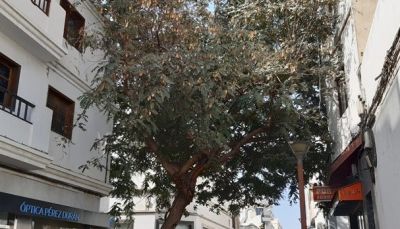
The Arrecife City Council has reported that last Saturday it was forced to cut down the tree located on Manolo Millares street "due to the problems it was causing in the area."
According to the Council, its roots were "aggressive" and were causing "a series of inconveniences in the place, such as the constant invasion of facades, lifting of pavements, colonization by the root system, problems in public lighting, in the water supply network as well as in its sanitation." "Therefore, its location was not ideal," it states.
Thus, the Department of Parks and Gardens states that it considered moving it to another location, but that the technical reports determined that "it was not possible". And it is that, the City Council affirms that "in addition to the necessary and drastic pruning to which the specimen would have had to be subjected", said activity would have involved carrying out "a large amount of work (lifting rigid pavements, excavations, affecting other facilities, replacement of facilities and pavements, etc.)" in order to remove an "important and considerable" part of its roots.
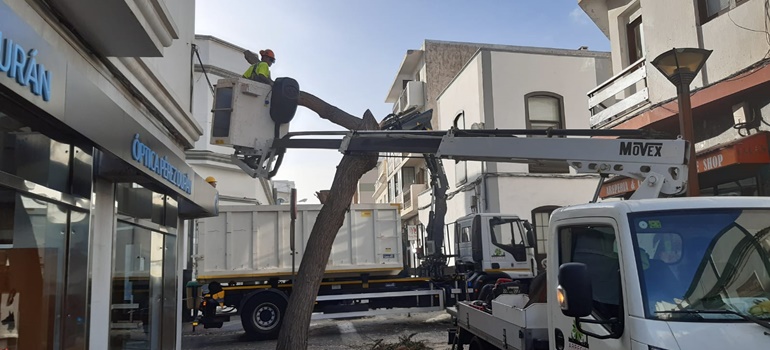
To all this, it adds that it would be necessary to add "the notable affectation, stress and physical damage to said root system to which the specimen would be subjected, so its transplantation to another location did not guarantee its survival.
The planting of other specimens is being studied
However, to compensate for the carbon footprint it absorbed, the Department of Parks and Gardens is studying the planting of other specimens located according to the precepts of the regulatory ordinance.
"We tried to move the specimen and do everything possible to maintain it. The problems that it caused and the impossibility of moving it led us to make that decision. We are working to ensure that Arrecife has more green areas and we will continue planting trees, yes, with the relevant reports and respecting the ordinance to avoid more cases like this," said the Councilor for Parks and Gardens, Tomás Fajardo, who states that the action was carried out under the reports of the technicians.
The City Council explains that the species, which was located in the center of the capital, was a 'Tipuana tipu' and is native to the subtropical forests of countries such as Argentina and Bolivia. At present it is widely cultivated in temperate regions of the United States and Europe. It is a deciduous tree with a height between 10 and 25 meters, with a dense, wide and extended crown with a very thick trunk.


