
With almost 78,000 immigrants arriving in the Canary Islands and thousands of lives lost at sea since the migratory route to the Canary Islands was reactivated in September 2019, the skipper of one of the rescue boats with the most rescues points out that at this point there are those who allow themselves to trivialize the danger faced by those who expose themselves to the waves in a miserable boat.
"Ignorance is very daring. Only people who know the sea, the same fishermen or sailors who have crossed the ocean in extreme conditions, can get a slight idea of what it is like to be in the middle of the sea in a boat that you don't know if it will capsize," Enrique Peña, captain of the Guardamar Polimnia, tells Efe.
Like many of his colleagues, Peña has already lost count of the people he has saved, but he does not hide the fact that his is a job that leaves marks, faces, looks, scenes that he will never forget. "I'm a tough guy, don't think so, but more than one night I've ended up here, crying," he confesses.
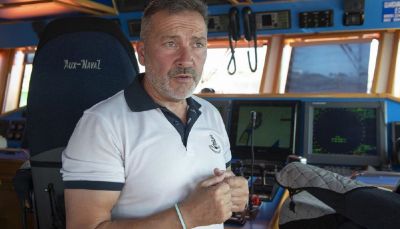
"Here" is the bridge of the Polimnia, moored to its twin the Guardamar Talía in the port of Arrecife (Lanzarote) waiting for an emergency warning to sound on the radio. He still has a few days left to finish his month on duty and hand over to other colleagues, so it is on the bridge of the Polimnia where this diver converted into a ship's captain explains how the Salvamento crews have experienced these four frenetic years on the Canary Route.
The interview takes place when the number of arrivals to the Canary Islands is close to 15,000 so far in 2023, before the tragedy that occurred on Sunday night in Lanzarote, which claimed another seven lives.
How have these months of service in the Canary Islands been?
Fortunately, when you use many resources for a problem, everything is directly proportional. Currently we have three of the four guardamares that Salvamento has in the Canary Islands, in addition to the salvamares (10 distributed on seven islands). It is true that these months the calms begin and there is an increase in migration. It usually happens the same every year, only now there is also a rebound with cayucos in the southern area that we had not seen for some time.
Of all these years, do you remember any particular rescue that, due to its circumstances, was etched in your memory?
I remember several. Especially one that happened when my daughter was still small, she would have been about two years old. It was a broken, semi-sunken inflatable boat. There were people in the water and we managed to get them on board without much difficulty, but one of the women kept screaming. She was looking for her daughter, who had disappeared. We found the body floating hours later. At that time we had new sailors, who had never faced picking up a corpse and it was a baby of about two years old. They took her out of the water very carefully and passed her to me. Her eyes were half open. Her gaze was etched in my memory. I have never forgotten it. It was in Almería, with the (Guardamar) Calíope.
What is the most delicate moment of the rescue?
When we approach, they always get nervous. Everyone wants to be saved as soon as possible and enters survival mode. My crew is very well trained. They must keep them calm and, sometimes, they have to act firmly, not harshly, but firmly. And checking if there are children is also very important.
Have you ever experienced a capsizing?
Several times. Some boats have more stability than others. The inflatable boats, which are talked about so much because they break, are more stable at the time of rescue. On the other hand, the ones we call short wooden boats, those have very bad stability. If their occupants go to one side because they all want to be saved at the same time, they capsize.
Have you had the opportunity to talk to the people you have rescued during the hours of navigation back to land?
When we were in the Arguineguín area, we always did the rescues from 150 miles (280 km) to the south. They were always like that and of course, when you return with people on deck, you find many situations, children, people who are not well, neither physically nor psychologically. We have had cases of people who have literally wanted to throw themselves into the water. Of catching them 'in extremis' and almost having to tie them up.
Have you ever taken the step of asking one of them: hey, what are you doing here in the middle of the sea?
Look, I was an emigrant, I went to France to look for work and a better life. I can understand it, I understand where they come from. We have found people in all kinds of situations, people, for example, without hands, from the war. I remember in particular a boy who came with his hands cut off, but he was happy. It's curious, isn't it? He was happy. And that makes you reflect.
You were with the Polimnia in Arguineguín in the autumn of 2020, with five rescues a day. How do you remember those months?
Five? At that time we had up to 13 consecutive rescues, without sleeping. That was a tremendous flood, impossible. It is one of the periods of most work that I remember having had in all the years that I have been in Salvamento.
And then return to a dock where there was no rest, where there were more than 2,000 people crammed together...
It was overwhelming, it was more like a ghetto.
Certain people maintain that the crossings in small boats are little less than whim trips, that Salvamento does not rescue its occupants, but rather provides a mere collection and transfer service... As a sailor, what would you say to those people about what it is like to be inside a boat like that 100 kilometers from land?
Ignorance is very daring. The sea at that distance becomes dark. That is the word, there is a tremendous darkness, there is no light pollution. If you are lucky, there are stars. But if the night is closed, it is tremendous, the sea roars... No, they obviously have no idea of what we experience on board and what we have seen. They have no idea... when we find corpses inside that those same people have been unable to throw into the sea, which would be the most logical thing to do, because their strength fails them.
What are the returns to land like with a deceased person on board next to those who were their traveling companions?
A couple of years ago we had a small boat in which there were three or four corpses. One was the brother of one of the survivors. He stayed until the last moment helping to carefully take out his brother. My crew tried to support him as much as possible. That kind of thing marks you, you know? They condition you. Joseph Conrad, who was a merchant navy captain in the 19th century, said that the ship on which we serve is the moral symbol of our existence. That can be applied to everything, to your way of working, to your life. Working on a Salvamento boat always conditions you.


