
Members of the Maritime Detachment of the Civil Guard intervened on April 29 fourteen fishing cages or fish traps, of large dimensions and without any identification in the vicinity of the coast, between Playa Blanca and Puerto Calero.
These fish traps violated different precepts included in the aforementioned legislation, such as the lack of mandatory beaconing of the gear, which must consist at its surface end of a reflective red or orange buoy with a minimum dimension of 20 centimeters in diameter and must have printed (on the buoys) the registration number of the boat to which it belongs and the name of the boat. In turn, the corresponding identification plate must be found on the body of the fish trap.
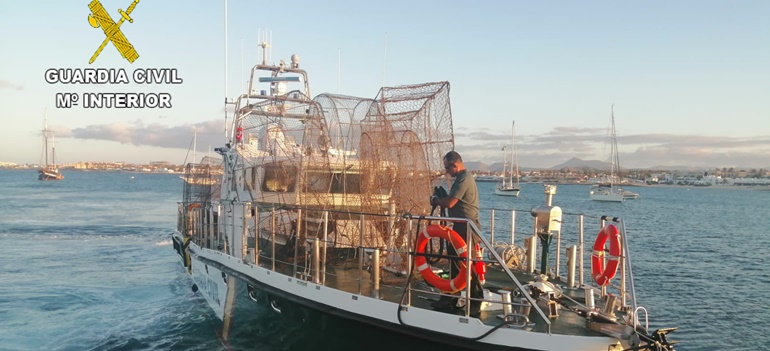
Given the knowledge that some professional fishermen use the fish trap gear without complying with the legal requirements, the crew of the Canal Bocayna patrol boat proceeded to search for fish traps using the probe and a bottom viewer or underwater vision device, since once a suspicious echo is located with the probe, the aforementioned vision device is used from the patrol boat to verify if it is indeed a fish trap.
The service focused on the coastal area between Playa Blanca and Puerto Calero, and once located and not having a buoy on the surface, with the help of a small anchor the agents hooked the submerged cable or the frame of the fish trap and brought them on board the patrol boat.
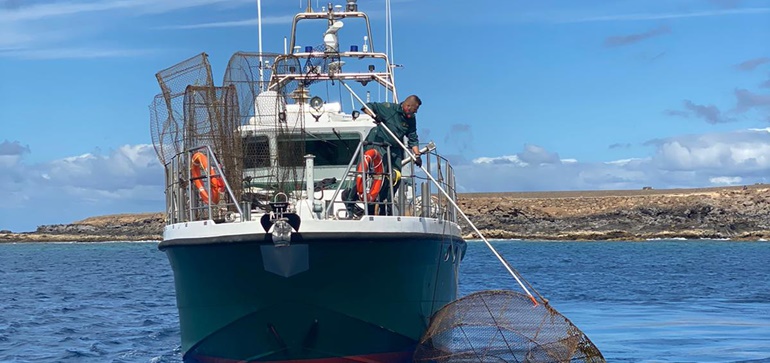
The fourteen fish traps were found distributed between the two aforementioned ports and at a depth of between 8 and 22 meters, with the minimum authorized depth being 18 meters. The fish that was inside the fish traps (abaes, samas, sargos, etc.) was immediately returned to the sea. The intervened fish traps were transferred and subsequently deposited in the Port of Corralejo, on the island of Fuerteventura.
Professional fishing boat reported
In addition, the same week, the agents of the aforementioned Maritime Detachment, also on board the Canal Bocayna patrol boat, reported a professional fishing boat from the port of Playa Blanca that, with two people on board, was in the vicinity of Punta Gorda fishing with fish traps without signaling or identifying them.
In this case, the skipper of the fishing boat was wearing a wetsuit, weights, diving goggles and fins, acknowledging that he was looking for the fish traps he had in the water. Once located, this fisherman dived to the fish trap and tied it up so that he could then bring it up to the boat, stating that he did not signal the fish traps so that other people would not lift them. The administrative complaint against this fisherman was sent to the Vice-Ministry of Fisheries and Agriculture of the Government of the Canary Islands.
The Civil Guard points out that this type of behavior makes the control of fishing with fish traps "very difficult" to carry out, resulting in "overexploitation of fishing by this fish trap on the island of Lanzarote and some areas of Fuerteventura." Likewise, it is stated that "some fishermen belonging to guilds of Lanzarote and illegally, set their fish traps in inland waters of the island of Fuerteventura, even though their use is prohibited."
Legislation
The Civil Guard recalls that it has an email address, [email protected], whose purpose is to provide general attention to citizens, also serving as a channel to receive information on matters that may initiate an investigation.
Regarding the use of fish traps, it is pointed out that it is regulated in Royal Decree 182/2004, of December 21 -article 25- which develops the Regulations of the Fisheries Law of the Canary Islands. These legal norms establish a series of provisions such as the regulation of the identification plates of the fish traps and the minimum depth, 18 meters, at which they must be located, as well as the beaconing of the same and permitted buoys.


