
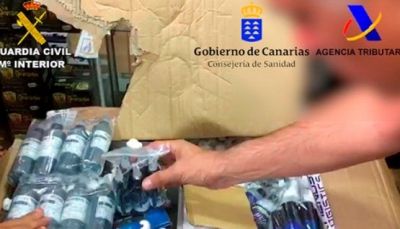
The Civil Guard, the Tax Agency and the Health Inspectorate of the Government of the Canary Islands have carried out a joint operation that has led to the dismantling of a network that introduced through parcels and distributed in the Canary Islands bottles of ink used for body tattoos not authorized by the Spanish Agency for Medicines and Health Products. In the operation, 43 people have been arrested and investigated in the archipelago, with eight being investigated in Lanzarote.
The 'Eternal Ink' operation began last January when agents identified in the Port of Light of Las Palmas de Gran Canaria a passenger who was going to board a ferry to the island of Fuerteventura, seizing 16 bottles of tattoo ink that were not on the official list of the website, available to the public, of the AEMPS, for which he was arrested for a crime against public health.
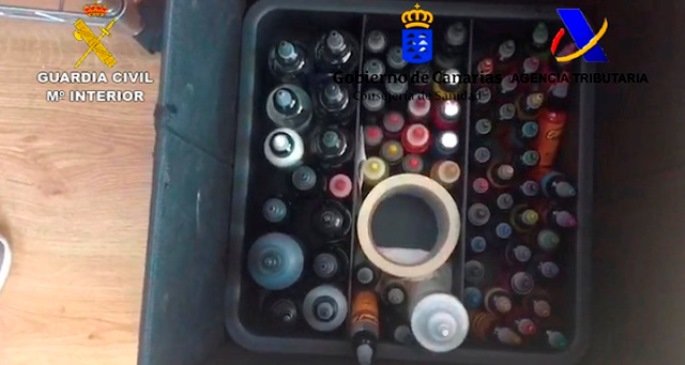
As a result of this finding, the agents continued with the investigation in order to determine both the origin and the recipients of these bottles, with the technical advice of the health inspectors of the General Directorate of Public Health of the Canarian Health Service and Customs Surveillance of the Tax Agency, so that a joint operation of both bodies was coordinated to try to intervene possible shipments of bottles of ink equal to those seized.
More than thirty investigated in four islands
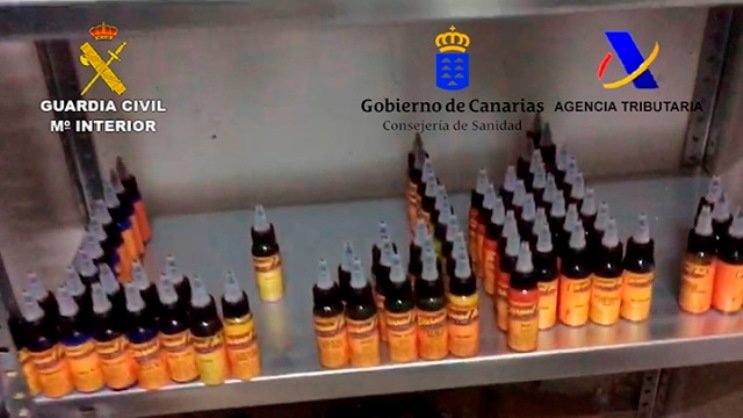
As a result of the investigations, it was possible to verify where the unauthorized ink bottles had been acquired, so the entry and registration of a tattoo business in Las Palmas de Gran Canaria was carried out, supposedly being the owner the main distributor of said ink in the Canary Islands. In the registration carried out, more than 1,000 bottles or containers of unauthorized inks were seized in a hidden room, so three people were arrested (the owner of the premises, his partner and an alleged employee), as alleged perpetrators of a crime against public health.
Likewise, in the remaining establishments inspected by the agents, it was possible to find bottles of unauthorized ink, as well as other unauthorized containers. These containers were always hidden so as not to be discovered before possible inspections, according to the Civil Guard.
Continuing with the investigations, the agents were able to verify that of all the inspections carried out in the Canary archipelago, only one establishment informed its clients of the use of these unauthorized inks, stating it on the consent form of each client, even though its use was prohibited. This information was reflected in a document called 'Informed Consent', of mandatory use for the premises, and where the client was warned of the risks of the technique and the inks. This consent is regulated and is a subject that is taught at the School of Health and Social Services of the Canary Islands.
In Gran Canaria, eight registrations were made, investigating 10 people and seizing 629 bottles of unauthorized ink. In addition, in a tattoo parlor in Mogán, the use of these inks to print documents is being investigated, so the provisional closure of said establishment has been carried out by the Health inspectors for the alleged commission of several infractions.
The device was also deployed on three other islands of the archipelago, including Lanzarote, where seven premises were inspected, with eight people being investigated and approximately 400 containers being seized. In Tenerife, 12 businesses were inspected, with 14 people investigated and 850 ink containers seized; while in Fuerteventura eight businesses were inspected, with several people being investigated and 290 ink containers being seized.
Smuggling and tax irregularities
The Civil Guard points out that during the development of the operation, several indications have been verified that point to a crime of smuggling, since a large part of the content of the packages and the sales documents issued by the exporter of these shipments did not coincide, since they used false concepts or changed the name of the supplier with the alleged purpose of avoiding police, health and customs surveillance.
In this way, both the exporters and the importers (several of the inspected premises) introduced the unauthorized ink bottles into the market, obtaining an illegal economic benefit from it, which was invested in other types of businesses and which continues to be analyzed in order to determine what irregularities may have been committed, according to the Benemérita.
The operation has been supervised by the Court of First Instance and Instruction number 8 of Las Palmas de Gran Canaria, coordinating the Security Detachment of the Civil Guard in the aforementioned Port of Light, the Canarian Health Service of the Government of the Canary Islands and Customs Surveillance of the Tax Agency, also participating different units of the Civil Guard such as the Reserve Unit, Fiscal Section of the Port and Local Police of Las Palmas de Gran Canaria.


