
The Santa Bárbara Castle, on top of the Guanapay volcano, will have a contemporary museography, accessible and immersive that will allow reinterpreting the ancient history of Lanzarote and the role of Teguise as the island's capital until the mid-19th century.
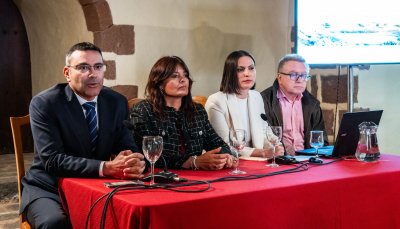
The Minister of Universities, Science and Innovation and Culture of the Government of the Canary Islands, Migdalia Machín, presented this Tuesday the new museum project in the Castle itself, accompanied by the president of the Cabildo of Lanzarote, Oswaldo Betancort; the mayor of Teguise, Olivia Duque; and the architect responsible for the design, Carlos Pallés.
During her speech, the minister stressed that “the history of La Villa is not only in books, but also in its streets, in its towers and buildings, whose stones still whisper what we were. Today we are taking an important step to preserve that story, reinforce our identity and project it towards new generations.”
The museographic proposal promoted by the General Directorate of Culture and Cultural Heritage "resolves the limitations of the building, typical of a defensive architecture, and transforms its interior into an exhibition route based on current solutions." "Ramps, accessible elements and technological tools that improve safety, inclusive understanding and enjoyment of the space are incorporated, without altering the heritage value of the complex."
Audiovisuals, augmented reality, video animation and digital resources will allow an immersive experience that links knowledge with emotion, favoring an unconscious assimilation of historical content. This is a museography that relies on the architecture of the Castle itself to contextualize the stories about the conquest, the defensive structures of the island and the transit of Teguise as capital until 1850.
The president of the Cabildo of Lanzarote, Oswaldo Betancort, valued the coordination between institutions to create a museum that collects the rich history of the old island capital. “In his day, as mayor, we managed to execute the complex integral restoration of the historical building; and now, thanks to the Canarian Government, we will make a museum a reality that strengthens the role of La Villa de Teguise as the epicenter of the history of Lanzarote and La Graciosa from the 15th century, with a powerful cultural and architectural heritage.”
For her part, the mayor Olivia Duque remarked that “this project returns the Castle to its role as a meeting place with history. Teguise is a heritage reference that deserves a renewed, living and accessible reading.”
Carlos Pallés explained that the new museography starts from respect for the original conditions of the building, resolving its structural limitations through contemporary solutions, and stressed that the objective is for visitors to “feel part of the history.”
In addition, it will be complemented by other historical spaces of La Villa, such as Casa Torres, recently acquired by the Government of the Canary Islands with the aim of ensuring its conservation and turning it into a cultural environment of reference.
Casa Torres and Castillo de Guanapay seek to consolidate themselves as "essential enclaves" to recount the biography of a community that "faced multiple challenges throughout the centuries." With both spaces, the Government of the Canary Islands defends "its commitment to the protection, conservation and dissemination of cultural heritage, offering didactic and accessible tools to rigorously understand the historical processes that have defined the identity of Lanzarote."


