
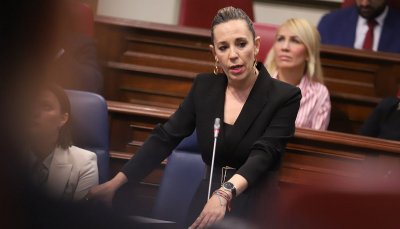
The Minister of Tourism and Employment of the Government of the Canary Islands, Jéssica de León, has proposed a grand pact for tourism linked to social, environmental and economic sustainability in which all political forces of the parliamentary arch, experts, academics and the entire Canarian society participate, “without demagoguery”. De León stated that “the objective is to create a committee of experts that sets common guidelines”.
This is what she defended during her speech in the Parliament of the Canary Islands, where she assured that “this Government is already working on improving the current tourism model, which places the resident at the center”. In this sense, she highlighted that in just nine months of management, the Executive has published the preliminary draft of the Law on Sustainable Planning of the Tourist Use of Housing and that the commitment is to continue working on the reform of the regulatory block of tourist activity, which is between twenty and thirty years old”.
“We invite you to join this reform, which we are convinced will allow us to recover the balance between the tourist and the resident that should never have been lost, and that will prevent processes such as touristification or gentrification from being accentuated”, she pointed out.
Next step: Canary Islands Tourism Planning Law
Thus, the next step on the legislative agenda, she specified, will be to address the Canary Islands Tourism Planning Law, which dates back to 1995, and then regulate campsites and camping. In addition, the decarbonization of the sector will continue to be promoted, which has managed to reduce its carbon footprint by 21% compared to 2022.
For De León, “the patience of the Canarian citizens has been exhausted and it is understandable”. She recalled that “the current Government has inherited a Canary Islands with four emergencies: water, energy, housing and migration. And at the same time, mortgages and the price of the shopping basket have risen”.
However, she insisted that “the tourist is not to blame for a political management that has been deficient” and assured that most of the Canarian citizens recognize the value of an industry that “has brought the highest levels of social welfare in the history of the Canary Islands, representing 40% of employment and 37% of tax collection in the islands, with 3,441 million euros”.
The counselor indicated that “a process has already begun where tourism is not an end but a tool to improve the lives of the Canarians”. In this line, she pointed out that we must talk about "how the wealth generated by the sector is distributed and how it can generate more and better jobs, but we must do it with foresight and common sense, putting the long lights to address in a serene way what tourism we want". And for this reason, she appealed to all the political forces of the parliamentary arch for an exercise of responsibility and coherence.


